
Website and Domain Migration is a structured process of moving a website to a new domain, hosting environment, platform, or URL structure while protecting SEO rankings, security, backlinks, and user trust. Following search engine best practices and authoritative guidance ensures a smooth transition with minimal traffic loss.
Introduction
Website and domain migration is a critical process that directly affects search engine visibility, user experience, and long-term online authority. Businesses migrate websites for various reasons, including rebranding, platform upgrades, hosting changes, security improvements, and scalability needs. While migrations are often strategic, they carry inherent risks: improperly handled transitions can result in ranking drops, broken links, indexing errors, or even temporary traffic loss.
A successful migration requires meticulous planning, technical precision, and careful attention to SEO and security. Search engines treat each URL as a unique entity, meaning changes in domain, URL structure, or protocols must be communicated clearly using 301 redirects, updated XML sitemaps, and accurate internal linking. Moreover, technical aspects such as DNS configuration, SSL validation, and server optimizations must be validated to prevent downtime or security vulnerabilities.
At FixHackedSite, we approach website and domain migration with a security-first and SEO-focused methodology. Every step is documented, tested, and aligned with Google Search Central best practices to ensure seamless transitions for users and search engines alike. This guide is designed to serve as a comprehensive, step-by-step roadmap, covering planning, execution, post-migration validation, and SEO preservation strategies. Whether you are performing a domain change, CMS migration, or hosting upgrade, following a structured approach minimizes risk and ensures long-term organic growth.
Understanding Website and Domain Migration
Website and domain migration refers to transferring a website from one digital environment to another while preserving content integrity, SEO value, and operational stability. This process may involve changing the domain name, moving servers, switching CMS platforms, restructuring URLs, or upgrading security protocols. Each variation introduces unique challenges that must be addressed through structured planning.
From an SEO standpoint, migration impacts how search engines understand URL relationships, historical authority, and relevance signals. Search engines treat each URL as a distinct entity, meaning changes must be clearly communicated using redirects, sitemaps, and crawl signals. Following Google Search Central best practices ensures that search engines can process these changes without penalizing visibility.
Technically, migration includes DNS updates, database transfers, file integrity verification, and server configuration changes. Strategically, it requires maintaining user trust, uptime, and performance benchmarks. A successful website and domain migration balances technical execution, SEO continuity, and security controls to ensure rankings remain stable and users experience no disruption.
Types of Website and Domain Migration
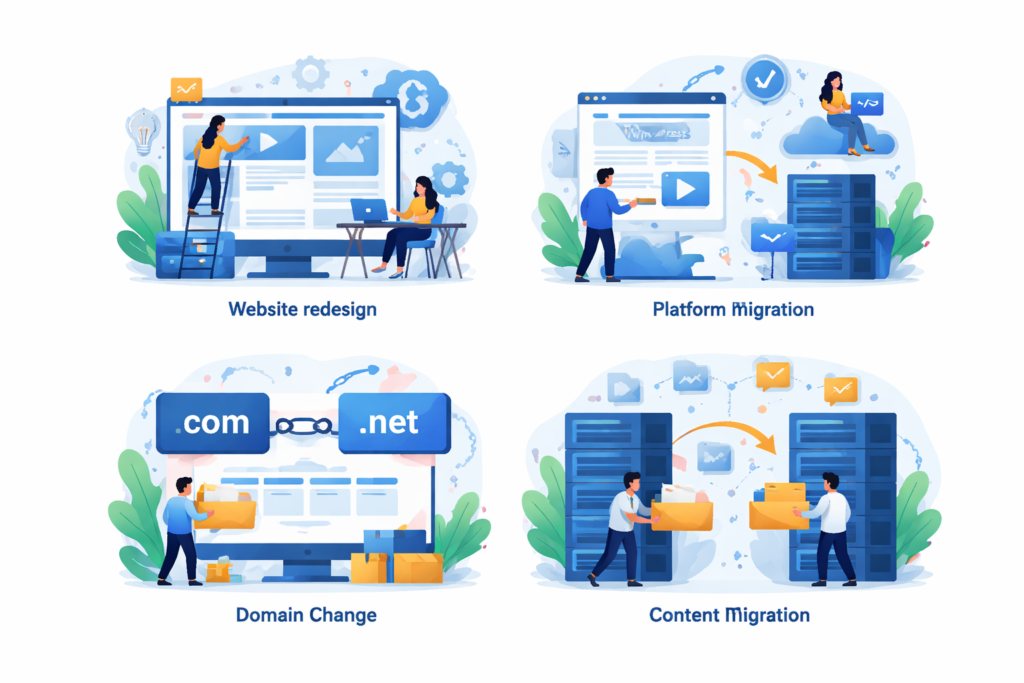
Website and domain migration can be categorized into several types, each with distinct SEO and technical considerations. The most common include domain migration, hosting migration, CMS or platform migration, URL restructuring, and protocol migration from HTTPS. Identifying the migration type early is essential for risk assessment and execution planning.
A domain migration involves changing the primary domain name, often due to rebranding or market expansion. This is the most SEO-sensitive migration type, requiring precise redirect mapping to transfer authority. Hosting migrations focus more on performance and security while keeping URLs unchanged. CMS migrations affect content structure, metadata, and internal linking, requiring careful validation.
Search Quality Evaluator Guidelines emphasize preserving content intent and trust signals during transitions. Each migration type must therefore be supported by documentation, testing, and post-launch monitoring to prevent quality degradation and ranking volatility.
Why Website and Domain Migration Impacts SEO
Website and domain migration impacts SEO because it alters how search engines crawl, index, and rank content. When URLs change or site architecture is modified, search engines must re-evaluate relationships between pages, backlinks, and relevance signals. Without proper implementation, this can lead to temporary or permanent traffic loss.
One of the most critical SEO factors during migration is link equity preservation. Backlinks pointing to old URLs must be redirected correctly to new destinations. According to Moz, a properly implemented 301 redirect passes most ranking signals and helps maintain authority. Poor redirect practices, such as chains or loops, dilute SEO value and slow crawling.
Migration also affects crawl budget, internal linking, canonical tags, and structured data. Search engines allocate limited crawling resources, and inefficient structures can delay re-indexing. SEO-focused migration ensures faster recovery, ranking stability, and long-term organic growth by maintaining continuity across all ranking signals.
Pre-Migration Planning and Documentation
Pre-migration planning is the most important phase of any website or domain migration. This stage involves auditing the existing website, documenting URL structures, benchmarking performance, and defining success metrics. Skipping proper planning is the leading cause of migration failure.
A comprehensive audit includes indexed URLs, top-performing pages, backlinks, crawl errors, and technical configurations. Tools such as Google Search Console provide insights into indexing status, coverage issues, and performance data that must be recorded before migration. These benchmarks allow accurate post-migration comparison.
Documentation ensures execution consistency and accountability. URL mapping documents define old-to-new relationships, technical documents outline server changes, and SEO documents preserve metadata and internal linking rules. Well-documented migrations reduce risk, improve coordination, and align execution with Search Quality Evaluator Guidelines.
Security Considerations During Migration
Website migration introduces temporary security risks if safeguards are not implemented correctly. DNS changes, file transfers, and server access updates can expose websites to malware injection, unauthorized access, and data leaks. Security must be integrated into every migration phase.
Before migration, websites should undergo malware scanning, file integrity checks, and permission audits. During migration, secure protocols and encrypted connections must be used. After migration, firewall rules, access controls, and security headers should be revalidated. Guidance from Cloudflare highlights the importance of securing DNS and infrastructure changes to prevent downtime and attacks.
Search engines actively penalize compromised websites, and hacked content is explicitly classified as low quality. A security-focused migration protects rankings, user trust, and brand reputation while ensuring long-term operational stability.
URL Mapping and Redirect Strategy
URL mapping is the backbone of SEO-safe website and domain migration. Every existing URL must be accounted for and mapped to its new destination to prevent broken links and ranking loss. A one-to-one redirect strategy preserves authority and ensures a seamless user experience.
Permanent 301 redirect rules should be implemented at the server level to signal long-term changes. Google recommends avoiding redirect chains and ensuring that redirects lead directly to final destinations. Clean redirect structures improve crawl efficiency and speed up re-indexing.
URL mapping should also include legacy URLs, parameterized pages, and high-value backlinks. Accurate mapping allows teams to monitor performance, identify issues quickly, and maintain full control over migration outcomes.
Content Integrity and SEO Signal Preservation
Content integrity plays a central role in maintaining SEO value during migration. Titles, meta descriptions, headings, internal links, schema markup, and media assets must be transferred accurately. Even minor inconsistencies can alter how search engines interpret relevance.
Google emphasizes maintaining the original purpose and value of content during structural changes. Internal linking structures must be updated to reflect new URLs, ensuring smooth navigation and crawl paths. XML sitemap should be regenerated and submitted immediately after migration.
Preserving content integrity ensures that rankings stabilize faster, users experience continuity, and trust signals remain intact. Migration is not the time for major content experimentation unless strategically planned.
Technical SEO Validation After Migration

After migration, it is essential to perform technical SEO validation to ensure the new environment functions as intended. This includes checking crawl errors, redirect accuracy, indexing status, page speed, and mobile usability. Immediate validation helps prevent long-term ranking issues.
Using Google Search Console, teams can monitor coverage reports, submit updated XML sitemap, and inspect key URLs. Log file analysis can reveal crawl behavior and highlight inefficiencies, helping to identify broken redirects or unexpected 404 pages.
Structured validation ensures that search engines understand the new site architecture, reducing recovery time and supporting long-term organic performance. A website that is technically sound post-migration is more likely to retain rankings and maintain a positive user experience.
Analytics & Tracking Post-Migration
Maintaining accurate analytics and tracking after migration is critical to measure success and detect potential issues early. Tools like Google Analytics and Google Search Console must be updated with the new domain or URL structure.
All goals, events, and conversion tracking scripts should be tested to ensure they fire correctly. Any discrepancies can result in misleading traffic and performance reports. Additionally, UTM tracking parameters in marketing campaigns must be reviewed to ensure continued campaign attribution.
Consistent tracking allows teams to identify pages that may be losing traffic, monitor the performance of 301 redirects, and evaluate changes in user behavior. Data-driven monitoring is essential for making informed post-migration optimizations.
Maintaining Backlink Equity
Backlinks are a core element of SEO authority. During migration, preserving backlink equity is essential to prevent ranking drops. Implementing a 301 redirect for every high-value page ensures that authority is transferred correctly.
Additionally, monitoring referring domains through tools like Ahrefs can identify links pointing to old URLs that may have been missed in the initial mapping. Outreach to high-value backlinks to update their URLs can further safeguard link equity.
Failing to maintain backlinks during migration can significantly reduce domain authority, resulting in decreased rankings and organic traffic. Careful planning and monitoring of link signals are therefore crucial for SEO continuity.
Performance & Speed Considerations
Website migration can affect site performance, which is a key ranking and user experience factor. Changes in server infrastructure, hosting provider, or content delivery network (CDN) can alter page load times.
Tools like Google PageSpeed Insights and Ahrefs site audits can evaluate performance post-migration. Optimizing images, scripts, and caching ensures minimal downtime and fast page delivery.
Maintaining or improving site speed during migration is essential, as slow-loading websites can hurt SEO rankings, user engagement, and conversion rates.
Structured Data & Schema Markup
Structured data communicates page intent and context to search engines. During migration, it’s vital to transfer schema markup correctly to preserve rich results, breadcrumbs, and product data.
Validating structured data using Google Search Console and Google Rich Results Test ensures there are no errors post-migration. Failure to migrate structured data can reduce visibility in rich snippets, impacting click-through rates.
Maintaining accurate schema markup helps search engines understand your site content, strengthens E-E-A-T signals, and preserves organic visibility.
International & Multi-Language Considerations

For websites targeting multiple countries or languages, migration planning must address hreflang tags, regional targeting, and canonicalization. Incorrect hreflang implementation can confuse search engines and reduce international visibility.
Tools like Ahrefs and Google Search Console allow verification of hreflang annotations and country targeting. Careful attention ensures users and search engines are directed to the correct localized content.
Neglecting international SEO during migration can result in lost traffic, incorrect indexing, and weakened authority across regions. Proper mapping and validation maintain global search performance.
Common Website & Domain Migration Mistakes
- Skipping Pre-Migration Audits – Not documenting URLs, backlinks, or top-performing pages leads to lost SEO equity.
- Improper Redirects – Chains, loops, or missing 301 redirects can dilute link equity and confuse crawlers.
- Neglecting Security – Unsecured DNS, SSL, or server configurations can expose the website to malware and penalties.
- Ignoring Analytics – Failing to update tracking scripts and goals can result in misleading performance data.
- Content Loss or Duplication – Altering page structure or content without strategy can negatively impact rankings.
By proactively addressing these errors, migrations can maintain rankings, traffic, and authority while reducing risk.
Frequently Asked Questions
Q1: How long does it take for rankings to stabilize after migration?
Rankings usually stabilize within 2–8 weeks after migration, depending on the number of URLs, redirects, and crawl efficiency. Continuous monitoring via Google Search Console helps detect issues early.
Q2: Should I use temporary 302 redirects instead of 301?
No, a permanent 301 redirect is essential to preserve link equity and SEO authority. Temporary 302 redirects may not transfer full ranking signals.
Q3: How can I ensure backlinks are preserved during migration?
Implement a complete URL mapping plan and track referring domains using Ahrefs. For high-value backlinks, consider outreach to update links pointing to old URLs.
Q4: Do I need to update XML sitemaps after migration?
Yes, submitting an updated XML sitemap in Google Search Console ensures that search engines can index the new URLs efficiently.
Q5: What security measures are important during migration?
Key security steps include DNS protection, SSL validation, encrypted file transfers, and malware scanning. Guidance from Cloudflare ensures the migration environment is safe from attacks.
Q6: Will a CMS migration affect my SEO?
Yes. Changing platforms can impact URL structure, internal links, metadata, and structured data. Careful planning and testing ensure SEO signals are preserved.
Q7: How do I handle international or multi-language sites?
Ensure proper implementation of hreflang tags, canonical URLs, and regional targeting. Use tools like Ahrefs and Google Search Console to verify that search engines recognize the correct language or regional pages.
Q8: Can migration cause a temporary drop in traffic?
Yes, minor fluctuations are common as search engines recrawl and index the new site. With proper 301 redirects, content preservation, and technical validation, traffic usually recovers quickly.
Q9: How do I validate structured data after migration?
Use Google Rich Results Test and Google Search Console to check schema markup. Correct structured data ensures rich results are retained post-migration.
Q10: What steps ensure minimal downtime during migration?
Plan the migration meticulously with pre-migration audits, redirect mapping, secure hosting setups, and staging environment testing. Monitoring with Google Search Console and server logs ensures any downtime is detected immediately.
Conclusion
Website and domain migration is a complex, high-stakes operation that requires meticulous planning, SEO alignment, and security validation. From URL mapping to content integrity, structured data, and performance monitoring, each step ensures rankings, authority, and user trust are preserved.
At FixHackedSite, we approach migration with a security-first, SEO-driven methodology, leveraging best practices from Google, Moz, Ahrefs, and Cloudflare. By following a structured, documented framework, businesses can achieve zero downtime, minimal traffic loss, and long-term search visibility.
Successful migration is not just technical—it is strategic, ensuring that your website continues to perform, rank, and grow in a competitive digital environment.