
Learn everything about website domains, including domain registration, DNS, security, SEO, branding, domain management, best practices, and expert strategies to build a secure and trustworthy online presence.
Introduction
A website domain is much more than an online address—it is the foundation of your digital identity. Whether you operate a personal blog, an eCommerce store, a corporate website, or a business portfolio, your domain name influences how users discover, remember, and trust your brand. Choosing the right domain can strengthen credibility, improve brand recognition, and contribute to a better user experience.
Many website owners spend considerable time designing attractive websites but overlook the importance of selecting, protecting, and managing their domain names. Poor domain management can lead to security risks, loss of customer trust, expired registrations, SEO issues, and even complete website downtime. A well-managed domain supports long-term business growth while helping maintain consistent accessibility for customers and search engines alike.
At FixHackedSite, we understand how important every aspect of website security and online presence is. This comprehensive guide explains everything you need to know about website domains, from selecting the perfect name and understanding DNS to protecting your investment with advanced security practices and maintaining long-term performance.
What Is a Website Domain?
A website domain is the unique, human-readable address visitors type into their web browser to access a website. Instead of remembering long numerical IP addresses assigned to web servers, users can simply enter an easy-to-remember domain name, making the internet more accessible and user-friendly. Every successful website depends on a properly configured domain that directs visitors to the correct hosting environment while supporting email services, security certificates, and other essential online functions.
A domain consists of several components that work together to identify a website on the internet. The most recognizable part is the domain name itself, followed by a Top-Level Domain (TLD) such as .com, .net, .org, .co.uk, or many newer industry-specific extensions. Together, these elements create a unique identity that distinguishes one website from millions of others worldwide. Choosing a domain that reflects your business, services, or brand can significantly improve memorability and encourage users to return.
Beyond branding, domains also play an important technical role. When someone enters your domain into a browser, the Domain Name System (DNS) translates that readable name into the IP address of the server hosting your website. This entire process occurs within milliseconds, allowing visitors to access your content quickly and efficiently. The Domain Name System (DNS) is managed through globally coordinated standards established by Internet Corporation for Assigned Names and Numbers (ICANN) and technical internet organizations.
A professionally selected domain contributes to credibility, customer confidence, and long-term brand recognition. Businesses that invest in a clear, memorable domain often enjoy stronger recognition in competitive markets because customers can easily remember and recommend their websites.
Why a Website Domain Is Essential for Your Online Presence
Your website domain represents your online identity long before visitors interact with your content. It is usually the first thing customers notice in advertisements, emails, social media profiles, search results, and business cards. A professional domain creates a positive first impression and communicates legitimacy, while a confusing or poorly chosen domain may discourage potential visitors before they even reach your website.
A memorable domain supports branding by reinforcing your business name and making it easier for customers to find you again. Consistency between your company name, domain, logo, and marketing materials builds familiarity and trust over time. This consistency becomes increasingly valuable as businesses expand into new markets or launch additional digital products and services. A domain that accurately represents your organization also reduces confusion when customers search online.
From an SEO perspective, domains contribute indirectly to search performance by encouraging user trust, improving click-through rates, and supporting long-term brand authority. Modern search engines prioritize helpful, trustworthy websites rather than relying on keyword-rich domain names alone. Google’s Search Essentials explain that high-quality content, excellent user experience, and technical reliability matter far more than attempting to manipulate rankings through domain names alone.
Security is another major consideration. Domains are central to SSL certificates, email authentication, DNS records, and website accessibility. If attackers gain access to your domain registrar account, they may redirect visitors to malicious websites, intercept emails, or disrupt business operations. Protecting domain accounts with strong authentication, registrar locks, and regular monitoring is therefore just as important as securing your website itself.
Ultimately, a website domain serves as the digital gateway connecting your audience with your business. Selecting the right domain and managing it responsibly lays a strong foundation for sustainable online success.
Understanding the Different Types of Website Domains
Choosing the right domain extension is nearly as important as selecting the domain name itself. Different Top-Level Domains (TLDs) communicate different purposes, audiences, and geographical relevance. Understanding these differences helps businesses make informed decisions that support branding, credibility, and future growth.
The most popular extension worldwide remains .com, widely recognized for commercial organizations and businesses of all sizes. Because of its familiarity, users often trust .com domains more readily than unfamiliar extensions. Other generic TLDs include .net, originally intended for networking organizations, and .org, commonly associated with nonprofit organizations, educational initiatives, and community groups. Today, many of these traditional distinctions are less strict, allowing businesses greater flexibility in selecting extensions.
Country-code Top-Level Domains (ccTLDs), such as .uk, .ca, .au, or .de, target specific geographic markets. Companies operating primarily within one country often benefit from country-specific domains because they reinforce local relevance and customer trust. International businesses sometimes register multiple country-code domains to support localized marketing campaigns and improve customer confidence across different regions.
Newer domain extensions such as .tech, .store, .online, .agency, and .shop provide additional branding opportunities for organizations seeking more descriptive web addresses. While these extensions can be creative and memorable, businesses should evaluate long-term recognition, customer familiarity, and overall branding strategy before choosing less common TLDs.
Another important consideration involves premium domains. Premium domains are short, highly memorable names that often command higher prices because of their branding potential. Although they may require greater investment initially, premium domains can deliver significant long-term marketing value through improved memorability and stronger brand positioning.
Regardless of extension, the most important factors remain clarity, simplicity, trustworthiness, and alignment with your organization’s goals.
How to Choose the Perfect Website Domain Name
Selecting the right website domain requires balancing creativity, branding, simplicity, and long-term business objectives. A well-chosen domain should remain relevant as your business grows while being easy for customers to remember, pronounce, and type accurately. Since changing domains later can affect branding, SEO, customer recognition, and marketing materials, investing time in the selection process is worthwhile.
The best domains are typically short, descriptive, and easy to spell. Avoid unnecessary hyphens, complicated abbreviations, numbers, or unusual spellings that may confuse visitors. If customers struggle to remember your domain after hearing it once, they may accidentally visit competitors or abandon their search altogether. Simplicity improves usability and reduces the likelihood of typing errors.
Your domain should also reflect your brand identity rather than chasing temporary keyword trends. Modern SEO emphasizes high-quality content, user satisfaction, and authority rather than exact-match keyword domains. Choosing a memorable brand name that customers associate with positive experiences often delivers stronger long-term results than selecting a generic keyword-focused address.
It is equally important to verify trademark availability before registering a domain. Accidentally selecting a name that infringes on an existing trademark can result in expensive legal disputes and forced rebranding. Conducting trademark searches, checking social media availability, and confirming business name consistency all contribute to a stronger digital identity.
Finally, think beyond today’s needs. Your domain should accommodate future expansion into additional products, services, or international markets without limiting your brand. A flexible, memorable, and trustworthy domain becomes a valuable long-term business asset that supports marketing, customer confidence, and sustainable online growth.
The Relationship Between Website Domains and Web Hosting
Although many people use the terms website domain and web hosting interchangeably, they serve two completely different purposes. Understanding how these components work together is essential for building, maintaining, and securing a successful website. A domain is your website’s address, while hosting is the physical location where your website’s files, databases, images, and applications are stored. Both are necessary for making a website accessible on the internet.
Think of your website as a house. The domain is the street address that helps visitors find your property, while the hosting server is the actual building containing everything inside. Without hosting, a domain points nowhere. Likewise, without a domain, users would need to remember a complex numerical IP address to access your website. Together, these technologies create a seamless browsing experience for users around the world.
When someone enters your domain into a browser, the request passes through the Domain Name System (DNS), which identifies the correct hosting server. The browser then connects to that server and retrieves your website’s files before displaying them to the visitor. This entire process typically happens in seconds and depends on properly configured DNS records, reliable hosting infrastructure, and secure network communication.
Modern hosting providers offer various hosting environments, including shared hosting, Virtual Private Servers (VPS), dedicated servers, managed hosting, and cloud hosting. The right choice depends on website size, expected traffic, security requirements, and business objectives. Small websites often begin with shared hosting before upgrading as traffic increases, while enterprise organizations typically invest in scalable cloud infrastructure that supports high availability and improved performance.
Another important consideration is choosing a hosting provider that integrates well with your domain registrar. Many providers simplify setup by offering one-click DNS configuration, SSL certificate installation, automated backups, and email management. These integrated services reduce technical complexity while improving website reliability.
Website performance is also influenced by hosting quality. Slow servers, outdated hardware, or overloaded hosting environments can negatively affect page speed, user experience, and search engine visibility. Google’s Core Web Vitals emphasize fast loading, responsiveness, and visual stability as important user experience signals.
Selecting reliable hosting combined with a professionally managed domain creates a strong foundation for website security, performance, and long-term online success.
How Website Domain Registration Works
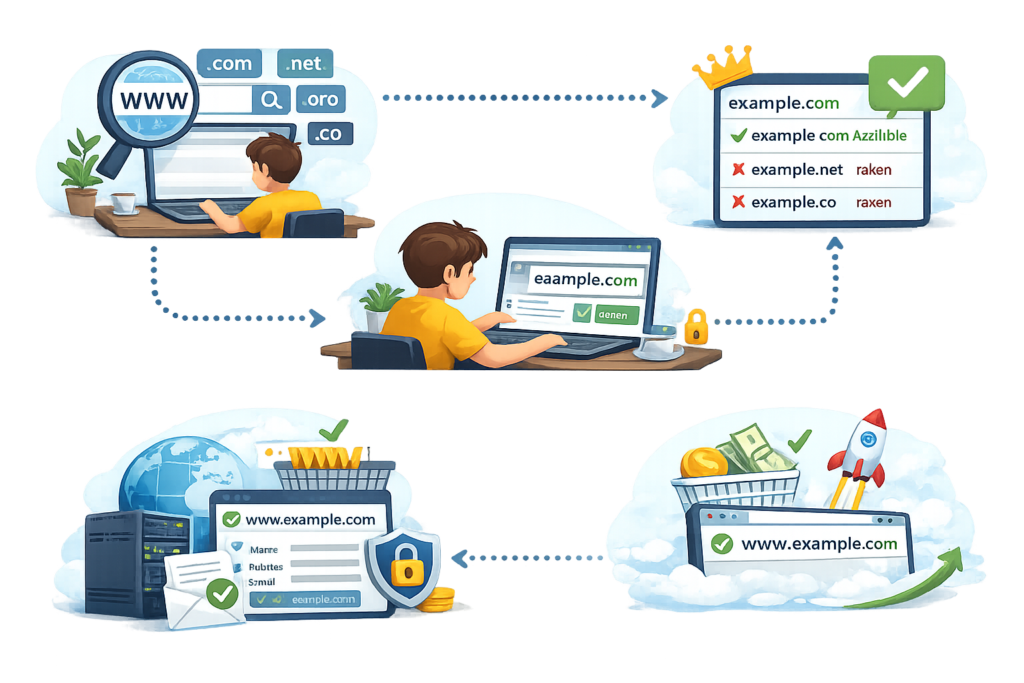
Registering a website domain is one of the first steps in establishing an online presence. Although the process appears simple, several organizations work together behind the scenes to ensure every registered domain remains unique and accessible worldwide. Understanding this process helps website owners make informed decisions and avoid common registration mistakes.
The journey begins by searching for an available domain name through an accredited domain registrar. Registrars maintain access to global domain registration databases, allowing users to verify whether their preferred domain is available. If the domain has not already been registered, it can usually be purchased for a registration period ranging from one to ten years. The registrar then records ownership details and submits the registration through globally recognized domain management systems.
The global coordination of domain names is overseen by the Internet Corporation for Assigned Names and Numbers (ICANN), which establishes policies ensuring every registered domain remains unique across the internet. Accredited registrars operate under ICANN guidelines to provide secure and standardized registration services.
During registration, website owners provide contact information for the domain owner, administrative contact, and technical contact. Many registrars now offer WHOIS privacy protection, which hides personal contact details from public databases while maintaining compliance with registration requirements. Privacy protection helps reduce spam, phishing attempts, and unwanted solicitations directed at domain owners.
Once registration is complete, the domain becomes active after DNS records are configured. Website owners can then connect the domain to their hosting provider, email services, content delivery networks, and other online platforms. Depending on DNS propagation, changes may take several hours to become visible globally.
It is also important to understand domain renewal policies. Domains are leased rather than permanently owned. If renewal deadlines are missed, the domain may enter a grace period before becoming available for public registration. Losing a valuable business domain due to expiration can result in significant financial losses, reputational damage, and customer confusion.
Organizations should enable automatic renewals, maintain updated billing information, and periodically review registration details to ensure uninterrupted ownership. These simple practices significantly reduce the risk of accidental domain expiration.
Proper registration is the beginning of responsible domain management. Combined with strong security controls and proactive monitoring, it provides a reliable foundation for maintaining a professional online presence.
DNS Explained: How Domains Connect to Websites
The Domain Name System (DNS) is often described as the internet’s phonebook because it translates human-friendly domain names into machine-readable IP addresses. Without DNS, users would need to remember lengthy numerical addresses every time they wanted to visit a website. Instead, DNS makes internet navigation simple, fast, and efficient.
Whenever someone enters a domain into their browser, a DNS lookup begins. First, the browser checks its local cache to determine whether it already knows the corresponding IP address. If not, the request travels through recursive DNS servers, root name servers, Top-Level Domain (TLD) servers, and authoritative name servers until the correct IP address is located. Once identified, the browser connects to the hosting server and loads the requested website.
Several DNS records play essential roles in website functionality. A Records connect domains to IPv4 addresses, while AAAA Records support IPv6 connectivity. CNAME Records allow one domain or subdomain to point toward another hostname, simplifying website management. MX Records direct email traffic to the appropriate mail servers, and TXT Records provide verification data used for email authentication, domain validation, and security technologies.
Proper DNS configuration is critical for website reliability. Incorrect records can cause website outages, email delivery failures, SSL certificate issues, and disrupted online services. Because DNS changes propagate across global networks, modifications may require several hours before becoming fully effective.
DNS also plays an important role in website security. Technologies such as DNSSEC (Domain Name System Security Extensions) protect DNS responses against manipulation and cache poisoning attacks by digitally signing DNS records. Implementing DNSSEC helps prevent attackers from redirecting users to fraudulent websites.
Website owners should regularly review DNS settings, remove obsolete records, and monitor for unauthorized changes. Many organizations also use redundant DNS providers to improve availability during infrastructure failures.
A properly configured DNS environment supports fast website performance, dependable accessibility, and strong cybersecurity. Understanding how DNS works enables website owners to troubleshoot problems more effectively while reducing downtime and protecting users from potential security threats.
Website Domain Security: Protecting Your Most Valuable Digital Asset
A website domain is one of the most valuable digital assets an organization owns. Unfortunately, domains are also attractive targets for cybercriminals seeking to hijack websites, intercept emails, redirect visitors, or impersonate trusted brands. Effective domain security requires continuous monitoring, strong authentication, and proactive risk management to prevent costly security incidents.
One of the most common threats is domain hijacking, where attackers gain unauthorized access to a domain registrar account and transfer ownership or modify DNS settings. Once compromised, users may unknowingly visit malicious websites designed to steal credentials, distribute malware, or conduct financial fraud. Recovering a stolen domain can be time-consuming, expensive, and damaging to a company’s reputation.
Strong authentication significantly reduces these risks. Every registrar account should use unique, complex passwords combined with Multi-Factor Authentication (MFA) to prevent unauthorized access. MFA requires users to verify their identity through an additional authentication factor beyond a password, making account compromise substantially more difficult.
Another essential safeguard is enabling Domain Transfer Lock (often called Registrar Lock). This feature prevents unauthorized transfers by requiring additional verification before ownership changes occur. Businesses should also activate domain expiration protection and automatic renewals to avoid accidental service interruptions.
DNS security deserves equal attention. Organizations should monitor DNS records for unexpected modifications, enable DNSSEC where supported, and review administrative access regularly. Email authentication standards including SPF, DKIM, and DMARC help protect domains from phishing attacks and email spoofing by verifying legitimate email sources.
Continuous monitoring is equally important. Many registrars provide alerts for DNS updates, ownership modifications, and login attempts. Security teams should investigate unusual activity immediately before attackers establish persistence within domain infrastructure.
Finally, businesses should maintain accurate ownership records, secure backup administrative contacts, and document domain recovery procedures. Regular security audits ensure domain settings remain aligned with organizational policies while identifying vulnerabilities before they can be exploited.
Protecting your website domain is not simply a technical task—it is a critical component of business continuity, customer trust, and cybersecurity resilience. Investing in strong domain security today helps safeguard your online presence against evolving digital threats for years to come.
Website Domains and SEO
A website domain indirectly influences SEO by improving trust, branding, and user recognition. While Google no longer gives ranking advantages to keyword-rich domains alone, a memorable and relevant domain can increase click-through rates and encourage repeat visits. A secure domain with HTTPS, clean URL structures, and reliable DNS contributes to a better user experience. Focus on publishing high-quality content, maintaining technical SEO, and earning quality backlinks rather than relying solely on your domain name. A strong brand domain combined with helpful content supports sustainable search visibility and long-term organic growth.
Common Website Domain Mistakes
Many website owners make avoidable mistakes when managing domains. Common issues include selecting long or confusing names, using multiple hyphens or numbers, forgetting to renew domain registrations, failing to enable Multi-Factor Authentication, and ignoring DNS security. Another mistake is purchasing domains without checking trademarks, which may result in legal disputes. Some businesses also choose trendy domain extensions that confuse users instead of trusted and recognizable options. Proper planning, routine monitoring, and secure registrar account management help prevent these costly errors.
Best Practices for Managing a Website Domain
Managing a website domain effectively requires ongoing attention rather than a one-time setup. Always enable automatic renewals, activate Domain Lock, use strong passwords, enable Multi-Factor Authentication, and regularly review DNS records. Keep contact information updated with your registrar and monitor your domain for unauthorized changes. Use SSL certificates, DNSSEC where available, and reliable hosting providers to improve security and performance. A proactive domain management strategy minimizes downtime and strengthens customer trust.
How to Transfer a Website Domain
There may be situations where you need to transfer your domain to a new registrar for better pricing, customer support, or additional features. Before starting the transfer, unlock the domain, verify administrative email access, disable transfer protection if necessary, and obtain the authorization code (EPP code). Initiate the transfer with your new registrar and approve confirmation emails. After the transfer is complete, verify DNS settings, SSL certificates, and email services to ensure uninterrupted website operation.
Future Trends in Website Domains
Website domains continue to evolve alongside internet technologies. Businesses are increasingly adopting industry-specific Top-Level Domains (TLDs), stronger DNS security, AI-assisted domain management, and improved automation tools. Privacy protection, DNSSEC adoption, and advanced threat detection are becoming standard practices. As cybersecurity threats continue to evolve, organizations will place greater emphasis on protecting digital identities while selecting memorable domains that support long-term branding and international growth.
Choosing the Right Domain Strategy for Business Growth
A successful domain strategy goes beyond selecting a memorable name. Businesses should register multiple domain variations to protect their brand, secure country-specific domains for international markets, and consider defensive registrations to prevent competitors or cybercriminals from exploiting similar names. Consistent branding across websites, social media platforms, and email addresses strengthens credibility while simplifying customer recognition. Long-term planning ensures your domain continues supporting future expansion.
Why Regular Domain Monitoring Matters
Your domain should be monitored just like any other critical business asset. Regular monitoring helps detect unauthorized DNS changes, suspicious login attempts, expired SSL certificates, and renewal issues before they affect website availability. Organizations should schedule periodic security reviews, verify registrar account settings, and maintain documented recovery procedures. Continuous monitoring reduces business risks, protects customer trust, and ensures your online presence remains stable.
Common Mistakes Website Owners Should Avoid
- Registering domains without trademark research.
- Choosing long, difficult-to-spell domain names.
- Forgetting domain renewal dates.
- Ignoring registrar account security.
- Not enabling Multi-Factor Authentication.
- Leaving unused DNS records active.
- Failing to implement HTTPS.
- Not using WHOIS privacy protection.
- Using unreliable domain registrars.
- Neglecting domain monitoring and regular audits.
Best Practices Summary
- Choose a short, memorable, brand-focused domain.
- Register your domain through a trusted registrar.
- Enable automatic renewals.
- Activate Domain Lock and Multi-Factor Authentication.
- Keep WHOIS information accurate.
- Use HTTPS and SSL certificates.
- Implement DNSSEC whenever supported.
- Monitor DNS records regularly.
- Secure business email authentication using SPF, DKIM, and DMARC.
- Review your domain strategy annually to support business growth.
Frequently Asked Questions
1. What is a website domain?
A website domain is the unique address people use to access your website instead of entering a numerical IP address.
2. How is a domain different from web hosting?
A domain is your website’s address, while web hosting stores your website’s files and content on servers.
3. How long can I register a domain?
Most registrars allow registrations from one to ten years, with renewal options available before expiration.
4. Does my domain affect SEO?
A domain contributes indirectly by improving branding, trust, and user experience, but content quality remains Google’s primary ranking factor.
5. Can someone steal my domain?
Yes. Without proper security measures such as Multi-Factor Authentication and Domain Lock, attackers may attempt domain hijacking.
6. What happens if my domain expires?
Your website and email services may stop functioning, and after the grace period another person could register your domain.
7. Should I purchase multiple domain extensions?
Yes. Registering common extensions helps protect your brand and prevents competitors or malicious actors from using similar domains.
8. How often should I review my domain settings?
Review your registrar account, DNS records, security settings, and renewal information at least every few months or after significant infrastructure changes.
Conclusion
A website domain is far more than a web address—it is the cornerstone of your digital identity, brand recognition, website security, and online credibility. Selecting the right domain, protecting it with modern security measures, and managing it proactively help ensure long-term business success. From choosing an appropriate domain extension and configuring DNS to implementing security best practices and planning for future growth, every decision contributes to a stronger online presence.
At FixHackedSite, we believe that effective website management starts with a secure and professionally managed domain. By following the strategies, best practices, and recommendations outlined in this guide, you can build a trusted online presence that supports performance, protects customers, and positions your website for sustainable growth.
Want to Implement This Easily?
Prompt Text:
You are an expert consultant. Based on the blog post titled “Website Domain”, provide a step-by-step, practical implementation guide. Include tools, best practices, common mistakes to avoid, and advanced tips. Assume the reader wants to implement everything discussed in this article effectively.
Call to Action:
Want our help implementing this? Just reach out to us via our website contact form: