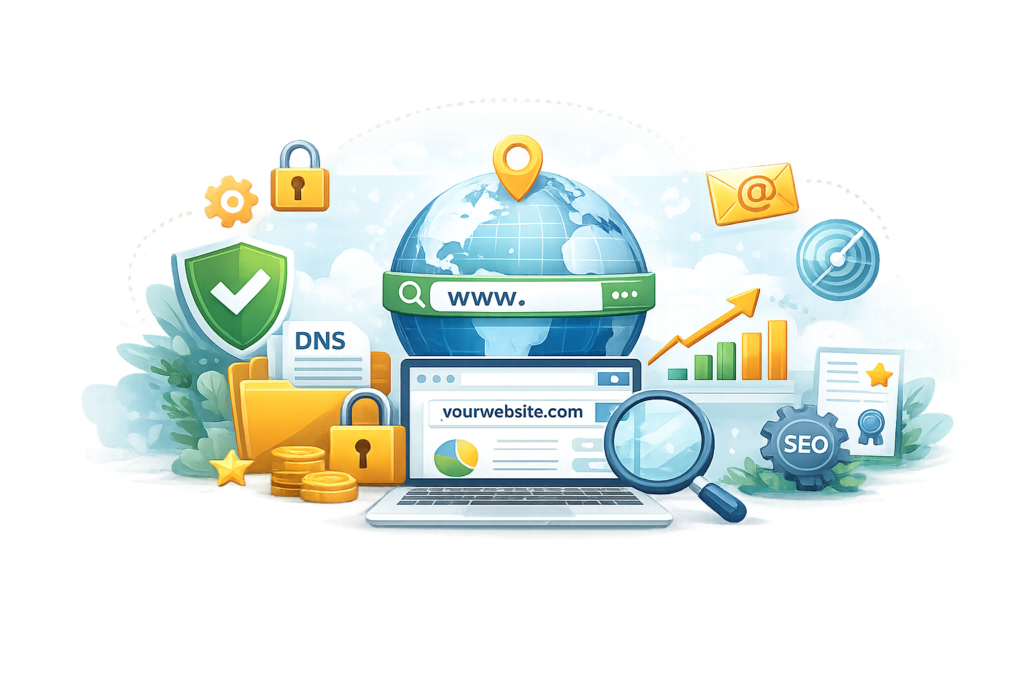
Website Domain is the foundation of every successful website. Learn how domain names work, how to choose the right domain, improve website security, protect your brand, enhance SEO, and follow industry best practices for long-term online success.
Introduction
A website domain is much more than an online address. It is the digital identity of your business, the first impression visitors receive, and one of the most important assets influencing branding, trust, security, and search engine visibility. Whether you operate a small business website, an online store, a blog, or a large enterprise platform, choosing and managing the right domain plays a significant role in your long-term success.
Many website owners focus heavily on website design, content, and marketing while overlooking the importance of their domain strategy. Unfortunately, poor domain decisions can negatively affect user trust, search engine optimization (SEO), email deliverability, cybersecurity, and brand recognition. A carefully selected domain combined with proper security measures creates a stronger foundation for sustainable online growth.
At FixHackedSite, we understand that a secure and properly managed website begins with a reliable domain strategy. This guide explains everything you need to know about website domains—from selecting the perfect domain name to protecting it against cyber threats, improving SEO performance, and following industry-recognized best practices recommended by trusted organizations such as Google Search Central Documentation and ICANN.
What Is a Website Domain and Why Does It Matter?
A website domain is the unique address people type into a web browser to visit your website. Instead of remembering complex numerical IP addresses, users simply enter a readable domain name such as example.com. This makes the internet easier to navigate while allowing businesses and individuals to establish a recognizable online identity.
Every domain consists of multiple components. The domain name itself represents your brand, while the extension—commonly called a Top-Level Domain (TLD)—includes endings such as .com, .org, .net, .co, or newer options like .shop, .tech, and .online. Behind the scenes, the Domain Name System (DNS) translates these human-readable names into machine-readable IP addresses, enabling browsers to locate the correct web server.
Beyond functionality, your domain has significant business value. It influences customer trust, professional credibility, marketing campaigns, and long-term brand recognition. A short, memorable, and relevant domain is easier for users to remember, share, and revisit. Businesses with well-chosen domains often enjoy stronger direct traffic, improved customer confidence, and better overall user experience.
A domain also serves as the foundation for professional email addresses, secure website hosting, SSL certificates, and numerous digital services. Losing control of your domain due to expiration or cyberattacks can lead to website downtime, lost revenue, damaged reputation, and potential legal issues.
Modern search engines do not rank websites solely because of their domain names, but a high-quality domain contributes indirectly by improving user trust, click-through rates, and brand recognition. According to Google’s Helpful Content guidance, websites should focus on creating trustworthy, people-first experiences rather than attempting to manipulate rankings through domain keywords alone.
When selecting a website domain, always prioritize clarity, simplicity, memorability, and long-term branding instead of chasing temporary SEO tactics.
Understanding How Domain Names Work Behind the Scenes
Although typing a website address appears simple, an advanced infrastructure operates behind every successful domain. Understanding how domains function helps website owners make informed technical and security decisions.
When someone enters your domain into a browser, the request first reaches the Domain Name System (DNS). DNS functions like the internet’s phonebook by converting human-friendly domain names into numerical IP addresses. Without DNS, users would need to memorize long sequences of numbers instead of meaningful website names.
The DNS lookup process involves several components. Recursive resolvers receive the initial request, root servers identify the correct Top-Level Domain, TLD servers locate the authoritative name server, and authoritative servers provide the final IP address. This entire process usually completes within milliseconds, allowing websites to load quickly.
Proper DNS configuration directly affects website performance, uptime, email delivery, and security. Misconfigured DNS records can result in inaccessible websites, failed email delivery, or vulnerabilities that attackers may exploit. Website owners should routinely review DNS settings to ensure accuracy and eliminate unnecessary records.
Modern DNS services also incorporate advanced security technologies such as DNSSEC (Domain Name System Security Extensions), which helps protect users against DNS spoofing and cache poisoning attacks. Organizations should consider registrars and DNS providers that support DNSSEC whenever possible.
Cloud-based DNS providers often include additional benefits such as faster response times, DDoS mitigation, automatic failover, traffic routing, and analytics. These features improve website reliability while reducing the likelihood of downtime during unexpected traffic spikes or cyberattacks.
Technical performance also depends on DNS propagation. Whenever changes are made to DNS records, updates require time to spread across global DNS servers. Understanding propagation delays helps administrators troubleshoot website migration, hosting changes, or SSL certificate installations more effectively.
Investing time in understanding DNS architecture ultimately improves website reliability, cybersecurity, and user experience.
Choosing the Perfect Website Domain for Long-Term Success
Selecting the right website domain requires strategic planning rather than quick decision-making. Your domain becomes part of every marketing campaign, social media profile, business card, email address, and customer interaction.
The ideal domain should be short, memorable, easy to pronounce, and simple to spell. Complicated words, unnecessary numbers, hyphens, and confusing abbreviations increase the likelihood of typing mistakes and reduce brand recall. Visitors should remember your domain after hearing it only once.
Brandability should always take priority over keyword stuffing. While descriptive words may help users understand your business, forcing multiple keywords into a domain often creates unnatural names that appear spammy. Search engines increasingly reward trustworthy brands rather than exact-match keyword domains.
Businesses should also consider future growth. A domain that reflects only one product or location may become restrictive as services expand. Selecting a broader, flexible brand name allows future diversification without requiring expensive rebranding efforts.
The choice of Top-Level Domain also matters. Although .com remains the most recognized extension globally, alternatives such as .org, .net, .io, .co, and industry-specific TLDs may suit different organizations. Businesses should evaluate customer expectations before selecting an extension.
Trademark research is another essential step. Registering a domain that infringes upon an existing trademark may result in costly legal disputes or forced transfers. Before purchasing a domain, verify trademarks, business registrations, and social media availability to maintain consistent branding across all platforms.
Many organizations also purchase multiple domain variations to prevent impersonation, phishing attacks, and competitor confusion. Defensive domain registration helps protect valuable brands while reducing opportunities for cybercriminals to exploit similar-looking domain names.
Finally, remember that a domain is a long-term investment rather than a temporary purchase. Choosing wisely today can save thousands of dollars in future rebranding costs while strengthening customer trust for years to come.
The Relationship Between Website Domains and Search Engine Optimization
A common misconception is that simply including keywords within a domain automatically guarantees higher rankings. Modern search engine algorithms have evolved significantly, making overall website quality far more important than keyword-heavy domain names.
According to Google Search Central Documentation, search rankings primarily depend on high-quality content, user experience, technical optimization, authority, and relevance. While domains contribute to branding and user trust, they are only one component of a much larger SEO strategy.
A memorable domain often improves click-through rates because users feel more comfortable visiting recognizable websites. Increased brand recognition also encourages direct traffic, repeat visitors, and organic mentions across social media, blogs, and news publications. These indirect benefits can positively influence long-term search visibility.
Consistency is another SEO advantage. Businesses should maintain one primary domain instead of creating multiple duplicate websites targeting identical keywords. Canonicalization, proper redirects, and consistent branding help search engines understand which version of the website should appear in search results.
HTTPS security also affects user confidence. Modern browsers warn visitors when websites lack SSL encryption. Secure domains not only protect sensitive information but also improve overall website credibility and support Google’s emphasis on secure browsing experiences.
International businesses should carefully evaluate country-code domains such as .uk, .ca, or .au versus generic domains like .com. Country-specific domains may strengthen regional visibility while generic domains often provide greater international flexibility.
Website migration involving domain changes requires careful planning. Incorrect redirects, broken links, missing metadata, or poor URL mapping can significantly reduce search rankings. Comprehensive migration strategies preserve SEO equity while minimizing traffic loss.
Ultimately, successful SEO depends on delivering exceptional user experiences, trustworthy information, technical excellence, and consistent branding rather than relying solely on domain-related keywords.
Website Domain Extensions Explained: Which One Should You Choose?
Choosing the right domain extension, also known as a Top-Level Domain (TLD), is an important decision that influences branding, credibility, audience perception, and sometimes regional targeting. Although many people automatically think of .com, hundreds of TLDs are now available, giving businesses and individuals more flexibility than ever before.
The .com extension remains the global standard because it is familiar, trusted, and widely recognized. Internet users naturally assume many businesses operate under a .com domain, making it the preferred option whenever available. Companies seeking international audiences often benefit from the strong reputation associated with .com.
Other generic TLDs such as .org, .net, .info, and .biz each serve different purposes. Non-profit organizations commonly choose .org, while technology companies sometimes use .io or .tech. E-commerce businesses may consider .shop or .store, though branding should always remain the highest priority.
Country-code TLDs (ccTLDs), including .uk, .de, .fr, .ca, and .au, are ideal for organizations targeting customers within specific regions. These extensions can strengthen local branding and improve user confidence among regional audiences.
Newer domain extensions continue to grow in popularity, but businesses should evaluate them carefully. While creative TLDs may enhance branding in certain industries, they may also require additional marketing efforts because users are less familiar with them. Before selecting any extension, consider customer expectations, future growth plans, and long-term credibility.
Regardless of the extension chosen, consistency, trustworthiness, quality content, and excellent user experience remain far more important than the domain ending itself.
Protecting Your Website Domain Against Cyber Threats

A website domain is one of your organization’s most valuable digital assets, making it an attractive target for cybercriminals. Domain hijacking, phishing, DNS manipulation, unauthorized transfers, and registrar account compromises can result in severe financial and reputational damage.
The first line of defense begins with choosing a reputable domain registrar that offers strong security features such as multi-factor authentication (MFA), domain locking, account activity monitoring, and secure recovery procedures. These protections significantly reduce the likelihood of unauthorized account access.
Domain locking prevents attackers from transferring your domain to another registrar without authorization. This simple feature has prevented countless domain theft incidents. Website owners should verify that registrar lock remains enabled unless legitimate transfer activities are underway.
Another critical security measure involves implementing SSL/TLS certificates, ensuring all website traffic uses HTTPS encryption. Trusted certificate authorities and initiatives like Let’s Encrypt make secure encryption accessible for websites of every size.
Organizations should also monitor domain expiration dates carefully. Expired domains may be purchased by competitors, cybercriminals, or domain investors, potentially leading to brand abuse, phishing attacks, or permanent business disruption. Enabling automatic renewal minimizes this risk.
DNS security deserves equal attention. Modern security technologies such as DNSSEC, secure DNS providers, and continuous DNS monitoring help prevent spoofing attacks and unauthorized record modifications.
Businesses should regularly review WHOIS information, registrar account permissions, administrative email addresses, and DNS configurations. Routine audits identify weaknesses before attackers exploit them.
A proactive approach to domain security protects customer trust, preserves search rankings, safeguards brand reputation, and supports long-term business continuity.
Domain Registration Best Practices for Long-Term Website Success
Registering a website domain is a simple process, but registering it correctly is what determines whether your website remains secure, professional, and reliable for years to come. Many businesses rush through domain registration without considering ownership, renewal policies, registrar reputation, or future business growth. These oversights often lead to expensive problems such as domain disputes, accidental expiration, unauthorized transfers, or even permanent loss of the domain. A strategic approach ensures your domain remains a valuable business asset throughout its lifecycle.
The first best practice is choosing an accredited and trustworthy domain registrar. Reputable registrars provide transparent pricing, secure account management, responsive customer support, automatic renewal options, DNS management tools, domain locking, and multi-factor authentication (MFA). Before purchasing a domain, review renewal fees, transfer policies, and additional services included in the registration package. A low first-year registration price may appear attractive, but unexpectedly high renewal fees can significantly increase long-term costs. Always review the complete pricing structure rather than focusing solely on promotional offers.
Domain ownership should always remain under the organization’s direct control rather than an individual employee, freelancer, or third-party agency. The business should use an official company email address for domain registration and ensure multiple authorized administrators can access the registrar account if necessary. Organizations should also maintain accurate registrant information to avoid complications during renewals, ownership verification, or legal disputes. While privacy protection helps shield personal contact details, registrars may still require accurate ownership information for administrative purposes.
Another essential practice involves registering your domain for multiple years whenever possible. Longer registration periods reduce the likelihood of accidental expiration while signaling long-term commitment to maintaining your online presence. Businesses should also enable automatic renewal and maintain updated payment information to prevent service interruptions. Although automatic renewal significantly reduces risk, website owners should continue monitoring expiration dates through regular account reviews.
Protecting your brand often means registering multiple domain variations. Purchasing common misspellings, alternative TLDs, and country-specific extensions helps prevent competitors or cybercriminals from exploiting similar names. This strategy reduces phishing risks while maintaining consistent branding across international markets. For businesses operating globally, registering relevant country-code domains may also support regional expansion and localized marketing initiatives.
Finally, document every aspect of your domain registration process, including registrar credentials, DNS settings, renewal schedules, administrative contacts, and recovery procedures. Proper documentation simplifies management during staff transitions and emergency situations while ensuring long-term operational continuity.
Domain Management and Renewal Strategies
Owning a website domain is only the beginning. Effective domain management requires continuous attention to security, renewals, DNS records, administrative access, and overall digital asset governance. Organizations that neglect ongoing domain management expose themselves to unnecessary operational risks, cybersecurity threats, and potential business disruptions.
One of the most important aspects of domain management is maintaining an accurate inventory of all registered domains. Many organizations own multiple domains for different brands, products, marketing campaigns, or international operations. Without centralized tracking, domains may expire unexpectedly or become vulnerable to unauthorized changes. Maintaining a comprehensive domain portfolio allows administrators to monitor ownership, renewal dates, DNS configurations, SSL certificates, and registrar accounts efficiently.
Automatic renewal should always be enabled whenever available. However, businesses should not rely exclusively on automation. Payment methods can expire, credit cards may be replaced, or financial institutions may decline transactions. Periodically verifying renewal settings and payment information reduces the possibility of accidental expiration. Organizations should also configure multiple reminder notifications several months before renewal dates to provide sufficient time for corrective action if necessary.
Administrative access should follow the principle of least privilege. Only authorized personnel should possess registrar account access, and permissions should be reviewed regularly. Former employees, contractors, or agencies should have their access removed immediately after project completion. Implementing multi-factor authentication significantly strengthens account security by requiring additional verification beyond passwords.
DNS records require regular maintenance as websites evolve. Obsolete records, unused subdomains, outdated email configurations, and legacy services should be removed to reduce security risks. Organizations should periodically review A records, CNAME records, MX records, TXT records, and SPF, DKIM, and DMARC configurations to maintain optimal website performance and email authentication.
Monitoring services can provide valuable insights into domain availability, DNS changes, SSL certificate status, and potential security incidents. Automated alerts enable administrators to respond quickly to suspicious activity before it affects website availability or customer trust. Proactive monitoring is particularly valuable for businesses operating mission-critical websites where downtime directly impacts revenue.
Well-organized domain management practices reduce operational complexity while strengthening security, improving reliability, and supporting long-term digital growth.
Website Domain Migration Without Losing SEO
Changing a website domain is one of the most technically challenging projects a business can undertake. Whether rebranding, merging businesses, or moving to a more appropriate domain, careful planning is essential to preserve organic search rankings, backlinks, customer trust, and website functionality. Poorly executed migrations frequently result in significant traffic losses that may require months to recover.
The migration process should begin with a complete inventory of existing URLs, internal links, metadata, structured data, images, downloadable files, and redirects. Every important page should have a corresponding destination on the new domain. Comprehensive URL mapping ensures that visitors and search engines reach the correct content after migration instead of encountering broken pages or unnecessary redirects.
One of the most critical technical requirements involves implementing permanent 301 redirects from every old URL to its equivalent location on the new domain. Proper redirects transfer much of the accumulated ranking signals while helping visitors reach the intended content seamlessly. Redirecting all pages to the homepage instead of their direct replacements creates poor user experiences and may reduce search visibility.
Internal links should also be updated to reference the new domain directly rather than relying on redirects. Navigation menus, footer links, canonical tags, XML sitemaps, structured data, image references, and downloadable resources should all reflect the updated domain. This reduces unnecessary redirect chains while improving crawling efficiency.
Website owners should also update external services, including analytics platforms, advertising accounts, email systems, CDN providers, payment gateways, and business directory listings. Search engines should receive updated XML sitemaps through Google Search Console, allowing faster discovery of new URLs and improved indexing.
Following migration, organizations should continuously monitor crawl errors, indexing status, traffic patterns, conversion rates, and server logs. Temporary ranking fluctuations are normal, but ongoing monitoring enables rapid correction of technical issues before they significantly affect visibility.
Successful domain migration combines careful planning, technical precision, comprehensive testing, and continuous monitoring. Organizations that prioritize user experience and follow recognized search engine guidelines can often preserve the majority of their existing SEO value during the transition.
Domain Privacy, WHOIS Protection, and Online Identity Security
Every registered domain contains ownership information maintained within registration databases. Historically, this information was publicly accessible through WHOIS records, allowing anyone to view contact details associated with a domain. While privacy regulations have changed how this information is displayed, domain privacy remains an essential component of cybersecurity and identity protection.
Domain privacy services replace publicly visible personal information with registrar-managed contact details, reducing exposure to spam, phishing attempts, identity theft, and unsolicited marketing. For individual website owners and small businesses, privacy protection significantly reduces unwanted communications while limiting opportunities for attackers to gather publicly available information.
Privacy protection, however, should not be confused with anonymous ownership. Registrars still require accurate ownership details for legal compliance, account verification, and dispute resolution. Providing false registration information may violate registrar agreements and create complications during transfers or ownership verification.
WHOIS protection also contributes indirectly to organizational security by limiting reconnaissance opportunities for cybercriminals. Attackers often collect publicly available information before launching phishing campaigns or social engineering attacks. Reducing unnecessary public exposure makes targeted attacks more difficult while strengthening overall digital security.
Businesses should periodically verify their domain registration information to ensure administrative contacts remain accurate. Changes in personnel, company addresses, or email systems should be reflected promptly within registrar records. Accurate ownership information becomes especially important during legal disputes, ownership transfers, or recovery procedures following account compromise.
Additional identity protection measures include enabling registrar locks, implementing multi-factor authentication, restricting account permissions, and monitoring unauthorized DNS changes. Combining privacy services with strong administrative security provides significantly greater protection than relying on privacy alone.
Organizations should also educate employees about domain-related phishing attacks. Fraudulent emails claiming domain expiration, payment issues, or registrar verification requests frequently target website administrators. Staff should verify communications directly through their registrar rather than clicking links contained within unsolicited emails.
Protecting domain ownership is not simply an administrative responsibility—it is a fundamental component of maintaining customer trust, business continuity, and long-term online reputation.
Common Website Domain Mistakes Businesses Should Avoid
Many domain-related problems are entirely preventable. Businesses often make avoidable mistakes during domain selection, registration, security configuration, or ongoing management that create unnecessary risks later. Understanding these common mistakes allows organizations to establish stronger domain management practices from the beginning.
One of the most frequent mistakes is selecting an overly complicated domain name. Long phrases, unusual spellings, excessive hyphens, or multiple numbers make domains difficult to remember, pronounce, and type correctly. Customers are more likely to mistype complicated domains, reducing direct traffic and increasing opportunities for competitors or malicious actors to exploit similar-looking names.
Another common error involves focusing exclusively on keywords rather than brand identity. While descriptive terms may provide context, keyword-heavy domains often appear unnatural and provide little long-term marketing value. Building a recognizable brand generally delivers greater benefits than attempting to optimize solely through domain naming.
Many businesses also neglect domain security after registration. Weak passwords, disabled multi-factor authentication, missing registrar locks, outdated contact information, and expired SSL certificates create vulnerabilities that attackers actively exploit. Security should be treated as an ongoing responsibility rather than a one-time configuration.
Allowing domains to expire represents another costly mistake. Even short periods of expiration can result in website downtime, email disruption, search ranking losses, and potential acquisition by third parties. Automatic renewal combined with proactive monitoring significantly reduces this risk.
Organizations sometimes register domains under the personal accounts of employees, freelancers, or external agencies instead of maintaining direct corporate ownership. This frequently creates legal and operational complications when relationships change or personnel leave the organization. Company-owned registrar accounts provide far greater long-term stability.
Finally, many businesses underestimate the importance of documentation. Losing registrar credentials, DNS records, recovery codes, or ownership records can dramatically increase recovery time during emergencies. Maintaining organized documentation ensures continuity while simplifying future migrations, audits, and security reviews.
Future Trends in Website Domains
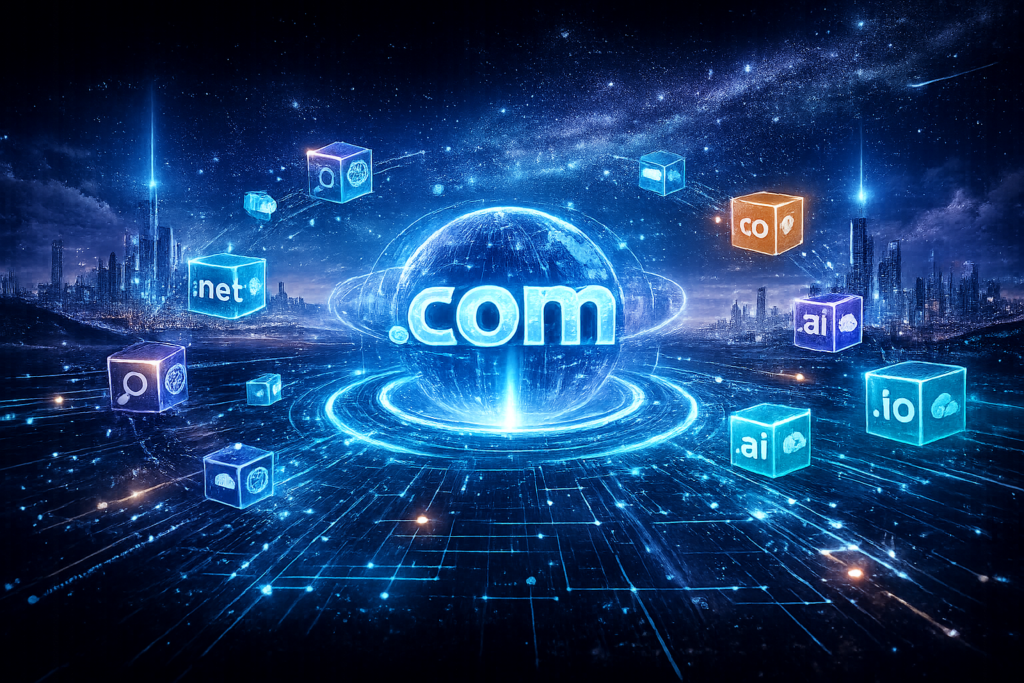
The internet continues to evolve rapidly, and website domains are evolving alongside it. New technologies, cybersecurity requirements, user expectations, and search engine advancements are shaping how businesses choose, manage, and secure their domains. Organizations that understand these emerging trends can make informed decisions that support long-term growth while protecting their digital presence.
One of the most noticeable trends is the increasing adoption of industry-specific Top-Level Domains (TLDs). While .com remains the most trusted and widely recognized extension, businesses are gradually embracing alternatives such as .tech, .store, .shop, .online, and .app when they align with their brand identity. These newer extensions provide greater flexibility for organizations that cannot secure their preferred .com domain. However, businesses should always evaluate customer familiarity and long-term branding before choosing a modern TLD.
Cybersecurity will continue to play a larger role in domain management. Features such as DNSSEC, registrar locks, multi-factor authentication, encrypted DNS protocols, and automated threat detection are becoming standard security practices rather than optional enhancements. Organizations that fail to implement these protections may become increasingly vulnerable to phishing campaigns, domain hijacking, and DNS attacks.
Artificial intelligence is also influencing domain management. AI-powered monitoring tools can detect unusual DNS activity, identify fraudulent domain registrations that resemble legitimate brands, monitor domain reputation, and alert administrators to potential security incidents before they escalate. These intelligent monitoring systems improve response times while reducing manual oversight.
Privacy regulations are another driving force behind domain management practices. Global regulations continue to influence WHOIS data accessibility, requiring organizations to balance transparency with personal data protection. Businesses should remain informed about regulatory changes affecting domain ownership records and privacy requirements.
Finally, search engines continue rewarding trustworthy websites that provide excellent user experiences rather than relying on technical shortcuts. Strong branding, secure infrastructure, reliable hosting, HTTPS implementation, fast website performance, and valuable content will remain the primary factors supporting sustainable online visibility. A well-managed domain serves as the foundation upon which all these elements are built.
Frequently Asked Questions
1. What is the difference between a domain name and web hosting?
A domain name is your website’s address on the internet, while web hosting is the server where your website files are stored. Both are required for a website to function. The domain directs visitors to the hosting server where your content is delivered.
2. Does having keywords in a domain improve SEO?
Not necessarily. Modern search engines prioritize helpful content, user experience, website authority, and trustworthiness over keyword-rich domains. A memorable brand-focused domain usually provides greater long-term value than forcing keywords into the domain name.
3. How long should I register my domain for?
Many businesses register domains for multiple years to reduce the risk of accidental expiration. Regardless of the registration period, enabling automatic renewal and regularly reviewing renewal settings is considered a best practice.
4. Can I change my domain name later?
Yes, but changing domains requires careful planning. Proper 301 redirects, updated internal links, revised XML sitemaps, and continuous monitoring are essential for preserving SEO value and maintaining a positive user experience.
5. What happens if my domain expires?
If a domain expires, your website and professional email services may stop working. Depending on the registrar’s policies, expired domains may eventually become available for public registration, allowing competitors or malicious actors to acquire them. Automatic renewal helps prevent this situation.
6. Should I purchase multiple domain extensions?
If your budget allows, purchasing common variations of your primary domain can help protect your brand from impersonation, phishing attacks, and customer confusion. Businesses operating internationally may also benefit from relevant country-code domains.
7. Is domain privacy protection necessary?
For most individuals and businesses, domain privacy protection is highly recommended. It helps reduce spam, phishing attempts, and exposure of personal contact information while supporting stronger online security.
8. How often should I review my domain settings?
A comprehensive review every few months is recommended. Verify DNS records, SSL certificate status, renewal settings, registrar account security, administrative contacts, and access permissions to ensure everything remains accurate and secure.
Best Practices Summary
Managing a website domain effectively requires more than simply purchasing a memorable name. Long-term success depends on strategic planning, proactive security, and ongoing maintenance. The following best practices provide a solid foundation for protecting your domain and maximizing its value:
- Choose a short, memorable, and brand-focused domain name.
- Register your domain through a reputable, accredited registrar.
- Enable automatic renewal and monitor expiration dates regularly.
- Protect registrar accounts with strong passwords and multi-factor authentication.
- Activate domain lock to prevent unauthorized transfers.
- Implement HTTPS using a trusted SSL/TLS certificate.
- Review DNS records periodically and remove obsolete entries.
- Keep ownership and administrative contact information current.
- Register relevant domain variations to protect your brand.
- Monitor your domain for suspicious activity and unauthorized DNS changes.
- Document registrar credentials, DNS configurations, and recovery procedures.
- Plan domain migrations carefully using permanent 301 redirects and updated XML sitemaps.
- Focus on user trust, website quality, and long-term branding rather than relying on keyword-heavy domain names.
Organizations that consistently follow these practices build stronger online credibility, improve operational resilience, and reduce the likelihood of costly security incidents or service interruptions.
Conclusion
A website domain is one of the most valuable digital assets any organization owns. It influences branding, customer trust, cybersecurity, search visibility, marketing effectiveness, and overall business credibility. Selecting the right domain is only the first step—maintaining it through proper registration, security, DNS management, privacy protection, and ongoing monitoring is equally important.
As technology continues to evolve, businesses that invest in responsible domain management will be better positioned to protect their online presence, support long-term growth, and deliver reliable experiences to their customers. By following recognized industry best practices and implementing a proactive security strategy, organizations can minimize risks while maximizing the value of their digital identity.
At FixHackedSite, we specialize in helping website owners secure, recover, and protect their online assets. Whether you need assistance with domain security, malware removal, website hardening, or recovering from a cyberattack, adopting the principles outlined in this guide will help you build a stronger and more resilient online presence.
Want to Implement This Easily?
Prompt Text:
You are an expert consultant. Based on the blog post titled “Website Domain”, provide a step-by-step, practical implementation guide. Include tools, best practices, common mistakes to avoid, and advanced tips. Assume the reader wants to implement everything discussed in this article effectively.
Call to Action
Want our help implementing this? Just reach out to us via our website contact form: https://fixhackedsite.com/contact-us/