
Protect your website with a Malware Removal Subscription Service that delivers continuous malware monitoring, rapid threat removal, proactive security updates, vulnerability management, and expert support to keep your website secure, available, and trusted by visitors and search engines.
Introduction
Every website connected to the internet is a potential target for cybercriminals. From small business websites and eCommerce stores to enterprise platforms and membership portals, malicious actors continuously scan the web looking for vulnerable websites they can exploit. Malware infections can happen without warning, resulting in stolen customer information, blacklisted domains, damaged search rankings, interrupted business operations, and costly recovery efforts. While many website owners believe security is something they only need after an attack occurs, modern cybersecurity proves that prevention and continuous protection are far more effective than emergency repairs.
A Malware Removal Subscription Service offers an ongoing security solution instead of a one-time cleanup. Rather than waiting until your website becomes infected, a subscription continuously monitors website activity, detects suspicious behavior, removes malware quickly, patches vulnerabilities, and strengthens overall website security before attackers can exploit weaknesses. This proactive approach significantly reduces downtime, improves website reliability, and helps businesses maintain customer trust while complying with modern security standards.
At FixHackedSite, we believe website security should never be reactive. Continuous monitoring, expert malware removal, proactive vulnerability management, and regular security improvements provide long-term protection against evolving cyber threats. This guide explains everything you need to know about Malware Removal Subscription Services, including how they work, their benefits, common threats, best practices, and why ongoing protection is essential for every modern website.
Understanding Malware Removal Subscription Services
Website malware has become increasingly sophisticated over the past decade. Cybercriminals no longer rely solely on obvious viruses or visible website defacement. Instead, they often install hidden malicious code that quietly steals information, redirects visitors, injects spam pages, mines cryptocurrency, distributes phishing campaigns, or creates hidden backdoors that allow repeated access to compromised systems. These attacks frequently remain undetected for weeks or even months, causing extensive damage before website owners realize something is wrong.
A Malware Removal Subscription Service addresses these challenges by providing continuous protection instead of temporary fixes. Unlike a one-time malware cleanup, which focuses only on removing an existing infection, a subscription service continuously scans website files, databases, themes, plugins, server configurations, scheduled tasks, and user activities for signs of malicious behavior. Advanced monitoring systems compare website files against trusted baselines, detect unauthorized modifications, analyze suspicious code patterns, and immediately alert security specialists whenever abnormal activity appears.
The greatest advantage of a subscription model is ongoing prevention. Security professionals continuously improve website defenses by installing security patches, reviewing software updates, monitoring firewall activity, analyzing login attempts, strengthening authentication policies, and identifying new vulnerabilities before attackers exploit them. This combination of continuous monitoring, proactive maintenance, and rapid incident response creates a far stronger security posture than relying solely on occasional malware scans or emergency cleanup services.
Why Modern Websites Need Continuous Malware Protection
Cyber threats have evolved dramatically. Automated attack bots now scan millions of websites every day searching for outdated plugins, weak passwords, exposed administrative panels, insecure APIs, vulnerable themes, and misconfigured servers. Many attacks require little human involvement because sophisticated scripts automatically exploit newly discovered vulnerabilities within hours of public disclosure.
Business websites face particularly high risks because they often collect sensitive customer information such as names, email addresses, payment details, login credentials, and confidential documents. A successful malware infection can expose this information, resulting in financial losses, legal consequences, regulatory penalties, customer complaints, and permanent damage to brand reputation. Even informational websites may become infected and unknowingly distribute malware to visitors, damaging user trust and reducing search engine visibility.
Continuous malware protection significantly reduces these risks by identifying suspicious behavior before attacks escalate. Real-time monitoring detects unauthorized file modifications, unusual database queries, unexpected administrator accounts, suspicious outbound connections, abnormal traffic patterns, and hidden malware signatures. Combined with routine security maintenance, vulnerability assessments, firewall management, and rapid malware removal, continuous protection creates multiple layers of defense that substantially improve overall website resilience against modern cyber threats.
How Malware Infects Websites
Understanding how malware enters websites helps organizations appreciate the importance of continuous security monitoring. Attackers typically exploit weaknesses rather than brute-force their way into systems. Outdated software remains one of the most common entry points because unpatched vulnerabilities often have publicly available exploit code. Once developers release security patches, attackers quickly identify websites that failed to update their software and launch automated attacks.
Weak authentication practices also contribute significantly to website compromises. Password reuse, predictable credentials, missing multi-factor authentication, insecure administrator accounts, and poor access management make it easier for attackers to gain unauthorized access. Once inside, malicious users may install hidden backdoors, upload malware, create additional administrator accounts, or modify website files to maintain long-term persistence.
Third-party integrations introduce additional risks. Plugins, themes, extensions, APIs, advertising scripts, analytics tools, and custom software may contain security vulnerabilities that attackers exploit. File upload forms, contact forms, abandoned plugins, insecure hosting environments, and improperly configured permissions also create opportunities for malware infections. Because new vulnerabilities appear regularly, continuous monitoring remains essential for identifying emerging threats before they become serious security incidents.
Common Types of Website Malware
Website malware exists in many different forms, each designed to achieve specific objectives. Some malware focuses on stealing sensitive information, while others generate advertising revenue, distribute spam, hijack website traffic, or provide remote access to attackers. Understanding these threats enables businesses to implement more effective security strategies and recognize suspicious behavior earlier.
Backdoor malware is among the most dangerous because it allows attackers to regain access even after passwords are changed or visible malware is removed. Hidden administrator accounts, encrypted scripts, modified configuration files, and concealed PHP code frequently provide persistent access. If backdoors remain undetected, attackers can repeatedly reinfect websites despite multiple cleanup attempts.
Other common malware includes ransomware, phishing pages, spam injection scripts, SEO poisoning malware, malicious redirects, cryptocurrency miners, web shells, JavaScript injections, fake plugin installers, and credential stealers. Modern attacks often combine multiple malware families within a single compromise, making professional analysis and continuous monitoring far more effective than relying solely on automated scanners. Subscription services continuously analyze these evolving threats and respond before they can cause extensive damage.
The Difference Between One-Time Malware Removal and a Subscription Service
Many website owners only seek professional help after discovering obvious signs of compromise, such as search engine warnings, unusual redirects, suspended hosting accounts, or customer complaints. While one-time malware removal restores a compromised website, it does not necessarily address the underlying security weaknesses that allowed the infection to occur. Without ongoing monitoring and maintenance, websites often become infected again within weeks.
A Malware Removal Subscription Service takes a proactive rather than reactive approach. Continuous monitoring identifies suspicious activity immediately, allowing security professionals to investigate incidents before they escalate. Routine vulnerability assessments, software updates, firewall optimization, malware scans, file integrity monitoring, security audits, and access reviews work together to reduce future attack opportunities significantly.
Subscription services also provide predictable security management. Businesses receive regular reporting, expert recommendations, ongoing risk assessments, priority incident response, and continuous improvements rather than relying on emergency support during security crises. This proactive model improves business continuity, protects customer trust, reduces downtime, and lowers long-term cybersecurity costs by preventing incidents instead of repeatedly recovering from them.
Key Features of a Professional Malware Removal Subscription Service
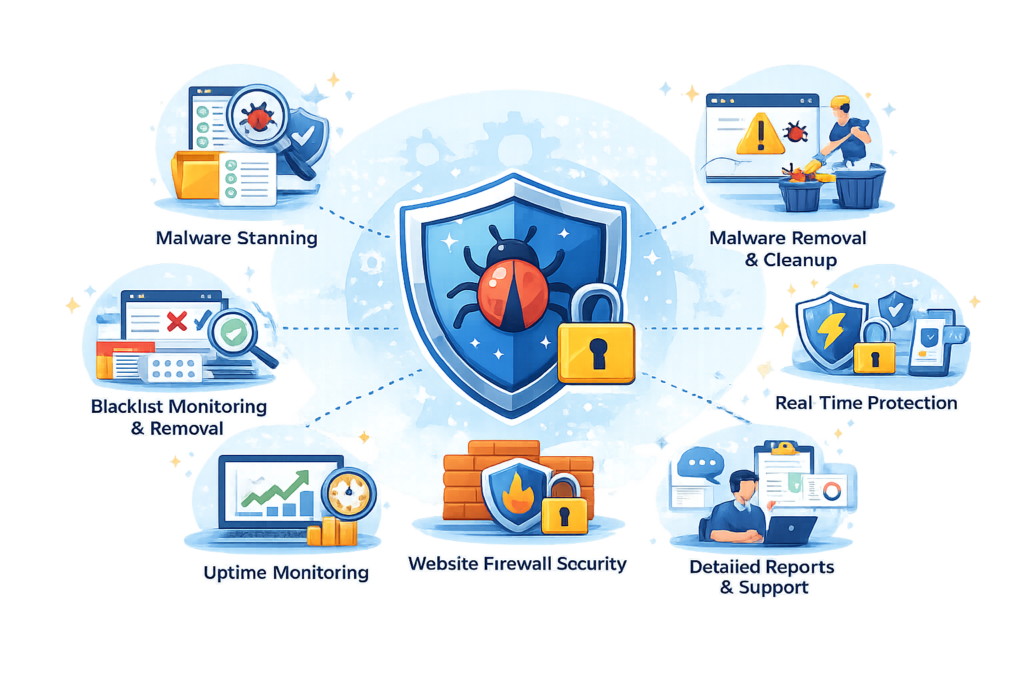
A high-quality Malware Removal Subscription Service provides much more than malware cleanup. It combines multiple cybersecurity disciplines into a comprehensive protection strategy that continuously improves website security. The most effective services include real-time malware detection, scheduled security scanning, firewall management, vulnerability assessments, software patch management, login security monitoring, file integrity verification, backup validation, and expert incident response.
Real-time monitoring forms the foundation of continuous website protection. Automated systems watch for suspicious changes in website files, unexpected database modifications, unauthorized administrator accounts, abnormal login attempts, unusual outbound traffic, hidden scheduled tasks, malicious code injections, and changes to critical configuration files. Early detection allows security teams to investigate threats before attackers establish persistent access or spread malware across multiple systems.
Professional subscription services also include expert human analysis. Security specialists investigate alerts, validate suspicious findings, remove malware safely, strengthen configurations, identify attack vectors, and recommend long-term improvements. Rather than relying entirely on automated tools, experienced analysts provide context, verify threats, reduce false positives, and continuously adapt protection strategies to address evolving cybercriminal techniques. This combination of advanced technology and cybersecurity expertise delivers stronger protection than automated scanning alone.
Benefits of Investing in Ongoing Website Security
Website security should be viewed as an ongoing business investment rather than an occasional technical expense. Every successful cyberattack has the potential to disrupt revenue, reduce customer confidence, increase operational costs, damage search visibility, and create legal or regulatory challenges. Continuous protection minimizes these risks while supporting long-term business growth.
A Malware Removal Subscription Service improves website availability by reducing unexpected downtime caused by malware infections, hosting suspensions, spam campaigns, or resource abuse. Visitors experience faster, more reliable websites, while businesses avoid emergency recovery costs and lost sales opportunities. Consistent security also strengthens customer confidence because users are more likely to trust websites that maintain secure browsing experiences.
Long-term protection also supports broader business objectives. Secure websites are easier to maintain, recover more quickly from incidents, comply with security regulations more effectively, and preserve valuable digital assets. Continuous monitoring identifies weaknesses before attackers exploit them, allowing organizations to improve cybersecurity gradually rather than reacting under pressure during major security incidents. Investing in ongoing malware protection ultimately protects reputation, customer relationships, business continuity, and future growth.
Monitoring and Detecting Malware Before It Causes Damage
Continuous monitoring is one of the most valuable components of a Malware Removal Subscription Service because it helps identify threats before they affect website visitors or business operations. Modern security platforms use automated scanning, file integrity monitoring, behavior analysis, and real-time alerts to detect suspicious changes. Monitoring both website files and databases ensures hidden malware cannot remain active for long periods without detection.
Professional monitoring also tracks login attempts, privilege changes, unexpected file uploads, and unusual outbound connections. These indicators often reveal attacks before visible symptoms appear. Regular security scans should follow recommendations from OWASP Web Security Testing Guide and security principles from the NIST Cybersecurity Framework to improve threat detection and incident response.
Organizations that continuously monitor their websites reduce recovery time, minimize business disruption, and strengthen customer confidence. Combining automated monitoring with expert review provides better protection than relying on manual inspections alone.
Vulnerability Management and Security Updates
Cybercriminals frequently exploit outdated software because publicly disclosed vulnerabilities are easy to automate. Effective vulnerability management identifies weaknesses before attackers can use them. A professional subscription service routinely reviews the content management system, plugins, themes, server software, third-party integrations, and custom code to identify potential risks.
Applying updates quickly is one of the simplest yet most effective security measures. Security patches often resolve critical vulnerabilities that attackers actively target. Guidance from CISA Secure by Design encourages organizations to prioritize secure configurations and timely patch management, while the Common Vulnerabilities and Exposures (CVE) database provides information about publicly disclosed vulnerabilities.
Regular vulnerability assessments reduce the attack surface, improve website stability, and lower the likelihood of malware infections. Combined with continuous monitoring, proactive updates form one of the strongest defenses against evolving cyber threats.
The Professional Malware Removal Process
Removing malware involves much more than deleting suspicious files. A structured response begins with identifying the infection source, isolating affected components, and preserving evidence for investigation. Security professionals then scan website files, databases, scheduled tasks, and server configurations to locate malicious code, hidden backdoors, and unauthorized user accounts.
After malware removal, experts repair compromised files, restore legitimate website functionality, and verify that no malicious code remains. File integrity checks, permission reviews, firewall adjustments, and password resets further strengthen the environment. Security recommendations published in WordPress Security help website owners maintain secure configurations after cleanup.
The final stage focuses on prevention by identifying how attackers gained access and implementing improvements that reduce future risks. This comprehensive process ensures the website is not only cleaned but also better protected against similar attacks.
Choosing the Right Malware Removal Subscription Service
Not every security provider offers the same level of protection. When evaluating a Malware Removal Subscription Service, businesses should look for continuous monitoring, rapid incident response, scheduled malware scanning, firewall management, vulnerability assessments, backup verification, and experienced security specialists. These capabilities provide comprehensive protection rather than simple malware cleanup.
Transparency is equally important. Providers should explain their monitoring process, response times, reporting methods, and security recommendations. Following Google Search Essentials demonstrates the importance of maintaining trustworthy, reliable websites that provide safe experiences for users. Strong security also helps maintain visibility in Google Safe Browsing by reducing the likelihood of malware warnings.
Selecting an experienced provider ensures ongoing protection, expert guidance, and continuous improvements that adapt to changing cyber threats while supporting long-term website reliability.
Website Backups and Disaster Recovery
Even with excellent security measures, every website should maintain reliable backups. A Malware Removal Subscription Service should include regular backup verification to ensure clean recovery points are available if malware, accidental deletions, or server failures occur. Backups should be stored securely in separate locations and tested regularly to confirm they can be restored successfully.
A complete disaster recovery plan defines how quickly a website can return online after a security incident. Recovery objectives, restoration procedures, and backup validation reduce downtime and protect business continuity. Guidance from the NIST Cybersecurity Framework emphasizes preparation and recovery as essential cybersecurity functions.
Reliable backups provide peace of mind while supporting faster incident response. Combined with continuous monitoring and proactive security management, disaster recovery planning helps organizations recover quickly and minimize the impact of unexpected cyber incidents.
The Future of Malware Removal Subscription Services
Cybersecurity continues to evolve as attackers adopt artificial intelligence, automation, and increasingly sophisticated attack methods. As threats become more advanced, businesses can no longer rely solely on traditional antivirus software or occasional security scans. A modern Malware Removal Subscription Service is evolving into a complete website security solution that combines real-time monitoring, automated threat detection, expert analysis, and proactive vulnerability management.
Artificial intelligence and machine learning now help security platforms recognize unusual website behavior before malware becomes active. These technologies analyze login patterns, traffic anomalies, file modifications, and application behavior to detect previously unknown threats. Security recommendations from CISA Secure by Design encourage organizations to build security into every stage of website management instead of treating it as an afterthought.
Businesses that invest in continuous website protection today are better prepared for tomorrow’s cyber threats. Ongoing monitoring, regular updates, and professional security oversight create a resilient security strategy that adapts to the constantly changing threat landscape.
Common Mistakes Website Owners Make
Many website compromises result from preventable mistakes rather than highly sophisticated attacks. One of the biggest errors is delaying software updates. Outdated content management systems, plugins, and themes frequently contain known vulnerabilities that attackers actively exploit. Ignoring security patches leaves websites exposed even when fixes are publicly available.
Another common mistake is relying only on one-time malware removal. Cleaning an infected website without addressing the underlying vulnerabilities often leads to repeated infections. Weak passwords, excessive administrator accounts, missing multi-factor authentication, poor backup practices, and unmonitored file changes also increase security risks. The OWASP Top 10 highlights many of these common security weaknesses and provides practical recommendations for reducing risk.
Finally, many businesses fail to monitor their websites continuously. Without ongoing monitoring, malware can remain hidden for weeks, causing reputational damage, search engine warnings, data theft, and financial losses before anyone notices the compromise.
Frequently Asked Questions
1. What is a Malware Removal Subscription Service?
A Malware Removal Subscription Service provides continuous website monitoring, malware detection, threat removal, vulnerability management, and ongoing security improvements instead of a single malware cleanup.
2. How often should my website be scanned?
Business websites should be monitored continuously with automated scans running daily or in real time depending on website traffic and risk level.
3. Can malware return after removal?
Yes. If security weaknesses remain unresolved, attackers may exploit the same vulnerability again. Continuous monitoring and regular updates significantly reduce this risk.
4. Does malware affect SEO?
Yes. Malware can lead to search engine warnings, reduced rankings, spam indexing, blacklisting, and loss of visitor trust. Maintaining compliance with Google Search Essentials helps support a trustworthy website.
5. Is a firewall enough to protect my website?
No. Firewalls are important but should be combined with malware scanning, vulnerability assessments, secure backups, software updates, and expert monitoring.
6. Are small business websites targeted?
Absolutely. Automated attack bots scan websites of every size, making small businesses frequent targets because they often have weaker security.
7. How quickly should malware be removed?
Immediately. Delayed removal increases the risk of data theft, customer impact, search engine penalties, and additional infections.
8. Why choose an ongoing subscription instead of one-time cleanup?
A subscription focuses on prevention, continuous monitoring, rapid response, and long-term protection, making it a more effective cybersecurity investment.
Best Practices Summary

Protecting a website requires a proactive security strategy rather than reacting after an attack occurs. The following best practices help reduce cyber risks and improve long-term website security:
- Keep the CMS, plugins, themes, and server software updated.
- Enable strong passwords and multi-factor authentication.
- Perform continuous malware scanning and monitoring.
- Review administrator accounts regularly.
- Schedule routine vulnerability assessments.
- Maintain verified off-site backups.
- Monitor file integrity and unusual activity.
- Use a properly configured web application firewall.
- Remove unused plugins, themes, and user accounts.
- Partner with experienced website security professionals for ongoing protection.
Conclusion
A Malware Removal Subscription Service is one of the most effective investments a website owner can make to protect digital assets, maintain customer trust, and reduce the risk of cyberattacks. Continuous monitoring, rapid malware removal, proactive vulnerability management, and expert security guidance create multiple layers of protection that significantly improve website resilience.
Rather than waiting for malware to disrupt your business, adopting a proactive security strategy helps prevent attacks before they cause lasting damage. At FixHackedSite, our goal is to help website owners maintain secure, reliable, and high-performing websites through continuous protection and professional security expertise. Investing in ongoing website security today provides stronger protection, greater peace of mind, and long-term business stability.
Want to Implement This Easily?
Prompt
You are an expert consultant. Based on the blog post titled “Malware Removal Subscription Service”, provide a step-by-step, practical implementation guide. Include tools, best practices, common mistakes to avoid, and advanced tips. Assume the reader wants to implement everything discussed in this article effectively.
Call to Action
Want our help implementing this? Just reach out to us via our website contact form: